Smart Sleeve
Wrist-Mounted Acoustic Command Transduction & Wearable Display System
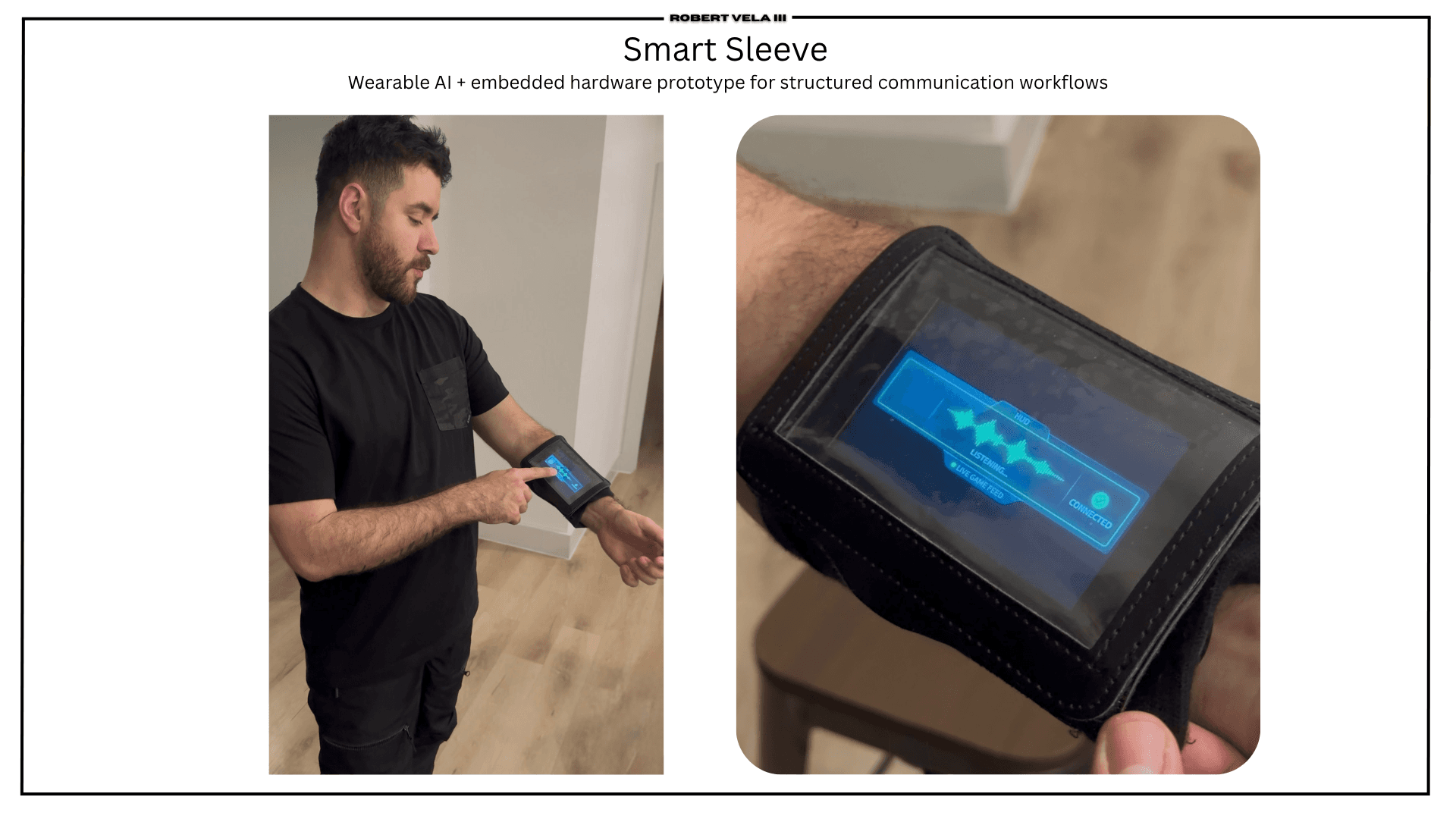
A distributed embedded architecture coupling a push-to-transmit acoustic capture node with a locally hosted automatic speech recognition (ASR) inference pipeline and a wrist-mounted raster display unit — enabling sub-3-second, voice-driven tactical schema rendering under field-operational constraints.
System Architecture
Three-Node Heterogeneous
Wireless Architecture
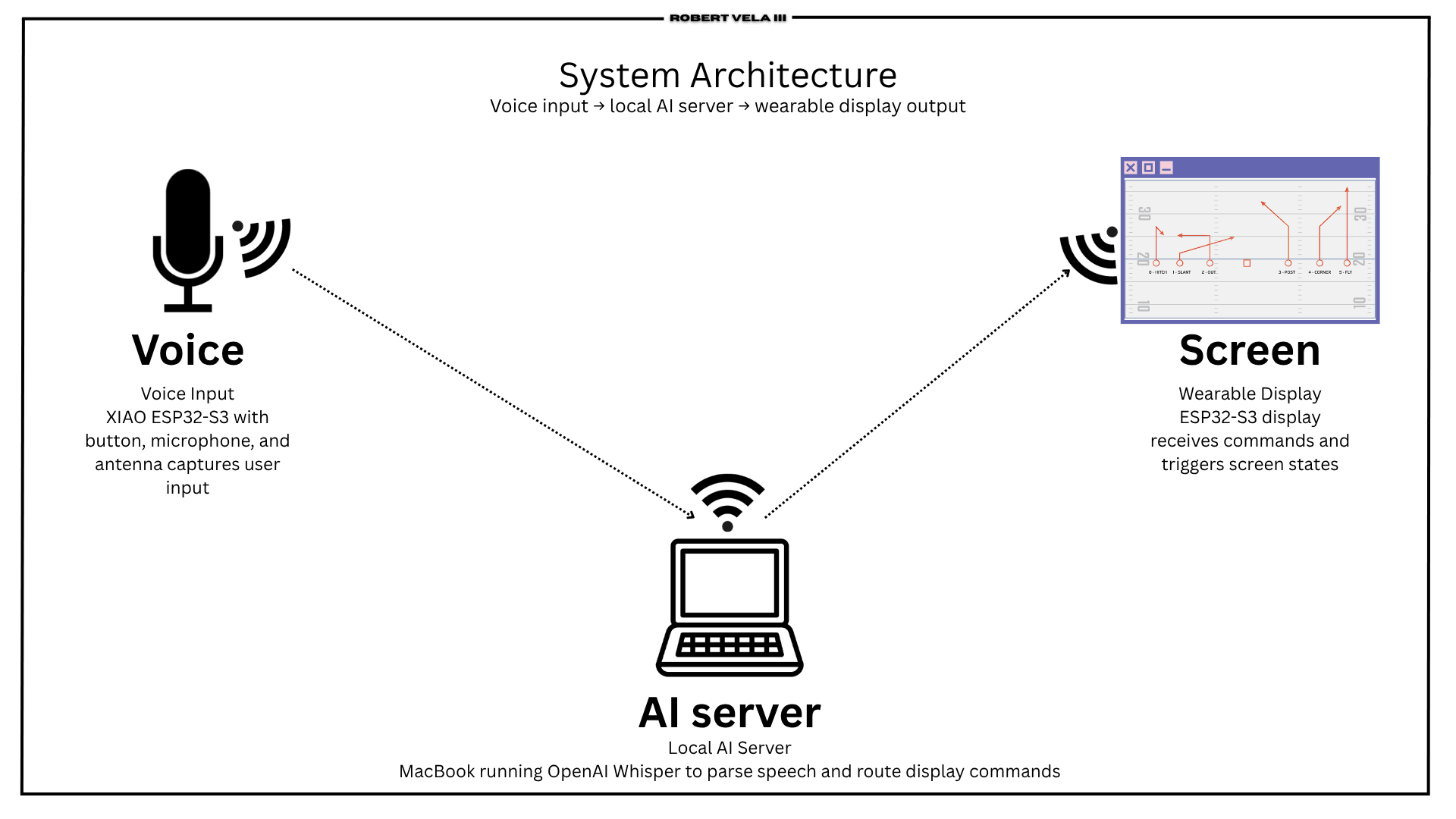
The system comprises three computationally distinct nodes communicating over a shared 2.4 GHz 802.11n network. Acoustic capture and display rendering are physically decoupled, with all lexical classification delegated to a server-side inference process — preserving computational headroom on both embedded endpoints.
- Capture Node —XIAO ESP32-S3 performs push-to-transmit (PTT) audio acquisition via its integrated MEMS microphone, persisting raw PCM to SD card as a .wav container. On deactivation, the node encapsulates the file in an HTTP/1.1 multipart/form-data POST and transmits to the inference server.
- Inference Server —A Python Flask process receives inbound audio, submits it to the Whisper tiny.en acoustic model for transcription, and performs lexical trigger classification against a predefined PLAYBOOK dictionary. Matched state is persisted in memory and exposed via a plain-text HTTP endpoint, with autonomous reset to a null-waiting state after a 5-second TTL.
- Display Node —An ESP32-S3-N16R8 interrogates the server endpoint at a 500 ms fixed cadence. On state change, the node performs substring classification of the response payload, loads the corresponding Binary RGB565 image from SD card into an 800 KB PSRAM framebuffer, and issues an LVGL immediate-flush call (
lv_refr_now(NULL)) to drive the 800×480 RGB panel.
Lexical Trigger Classification Map
"blitz"
BLITZ PICKUP → /blitz.bin
"screen"
SCREEN PASS → /screen.bin
"map"
GLOBAL MAP → /map.bin
"red"
FORMATION RED → /red.bin
Server state autonomously degrades to null-waiting at T+5 s post-classification; display node detects transition and reloads the standby framebuffer.
Embedded Hardware
Parallel-Rail Dual-MCU
Power Delivery Topology
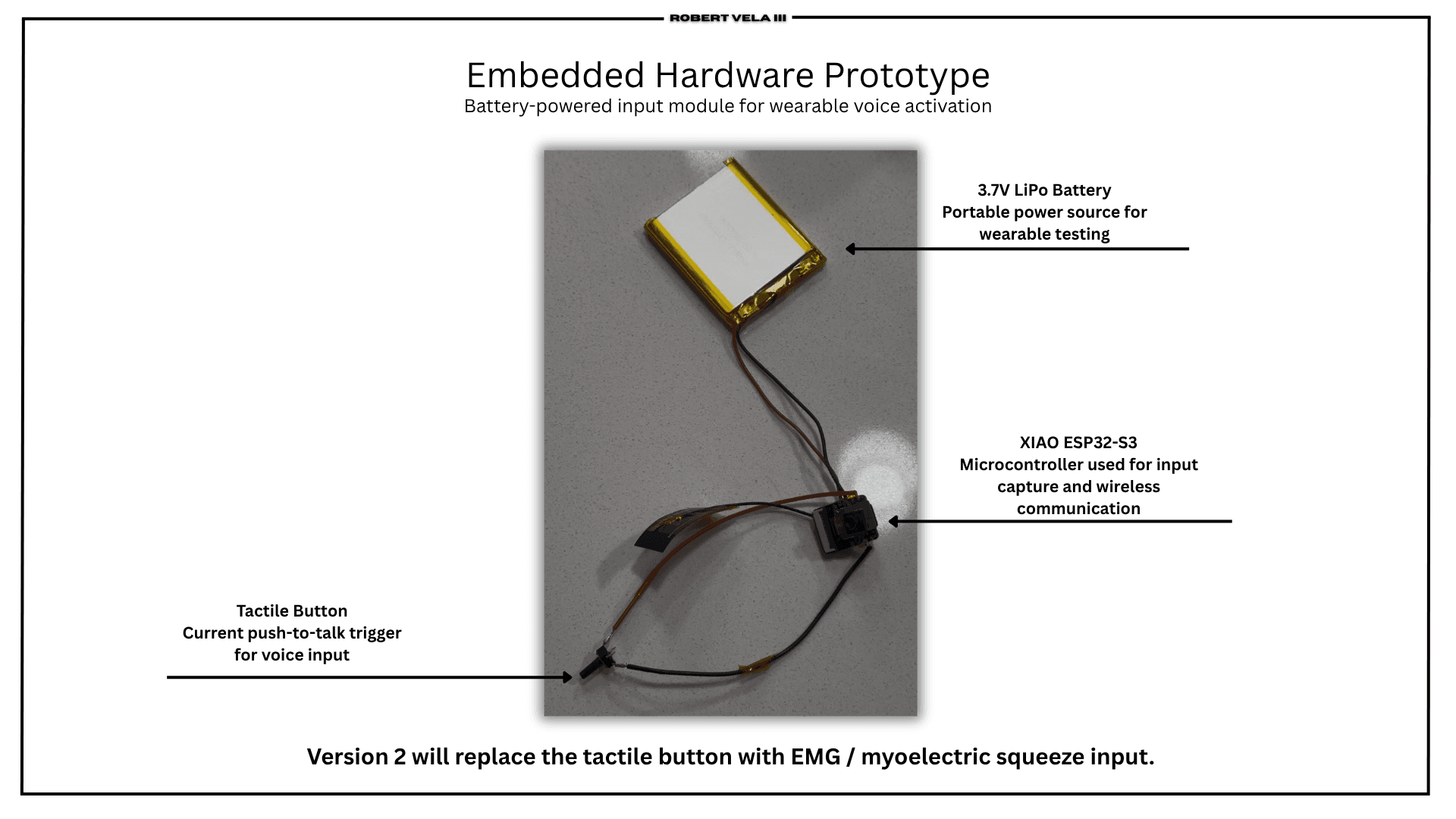
Both MCU subsystems are energized concurrently from a single 3.7 V / 2500 mAh LiPo cell via a Y-harness splice topology. The display board required a deliberate hardware modification: a jumper wire soldered to the cathode side of protection diode D3 enables direct battery-rail injection into the USB-5V plane, circumventing the ~700 mV forward-voltage drop that would otherwise produce an undervoltage lockout condition at nominal cell voltage.
Charge ingress is exclusively routed through the XIAO USB-C port and its onboard PMIC. Concurrent USB attachment to the display node while the battery is live introduces an unregulated back-feed path into the LiPo cell — a hazard condition requiring a mandatory battery disconnect prior to any display-side firmware update operation. Aggregate active draw is approximately 380 mA, yielding ≈ 6.5 h of continuous operational runtime at a 0.152 C discharge rate.
Bench Validation Protocol
Pre-Enclosure Functional Checkout
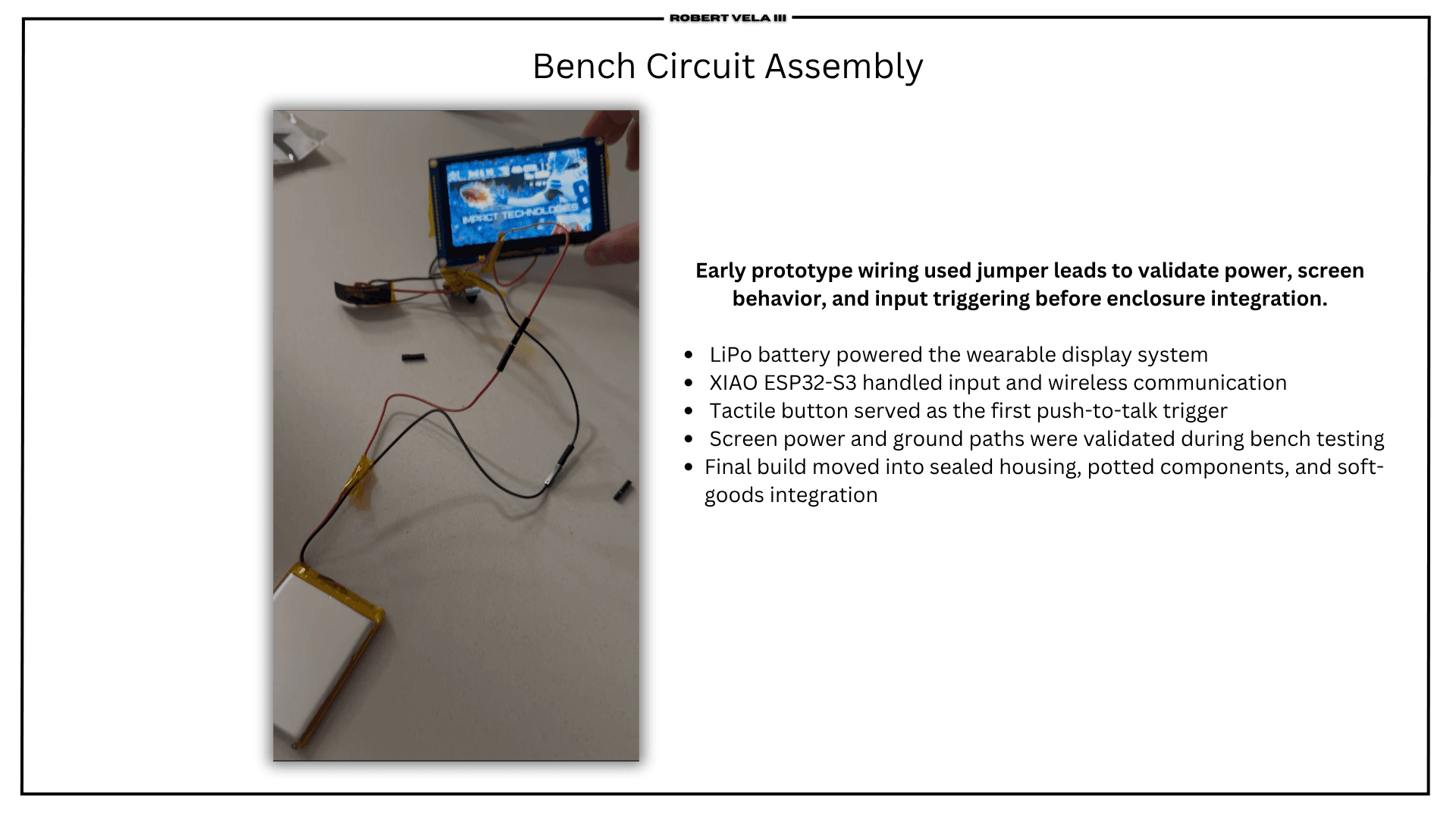
Pre-integration validation was conducted using jumper-lead harnesses and a regulated bench supply configured to 4.00 V / 1.00 A — approximating an 80%-state-of-charge LiPo cell while providing 620 mA of current headroom above nominal draw to absorb inrush transients during MCU boot.
- Steady-state current draw verified at 370–400 mA prior to full boot sequence
- D3-bypass rail continuity confirmed through cathode injection point
- PSRAM allocation and 800 KB framebuffer integrity verified on serial output
- SD card image load and LVGL framebuffer flush cycle validated end-to-end
- Final assembly potted into sealed enclosure and soft-goods substrate
Hazard Operability Analysis (HAZOP)
A concurrent USB attachment hazard was identified during HAZOP: connecting a USB-C cable to the display node while the LiPo cell is live creates an unregulated back-feed path into the battery rail through the D3-bypass modification. This constitutes a LiPo cell back-charge condition outside the PMIC protection envelope. Formal hazard control: mandatory battery-disconnect-before-display-USB-attachment procedure, documented in the commissioning protocol.
Display State Machine
Three-State Framebuffer
Transition Sequence
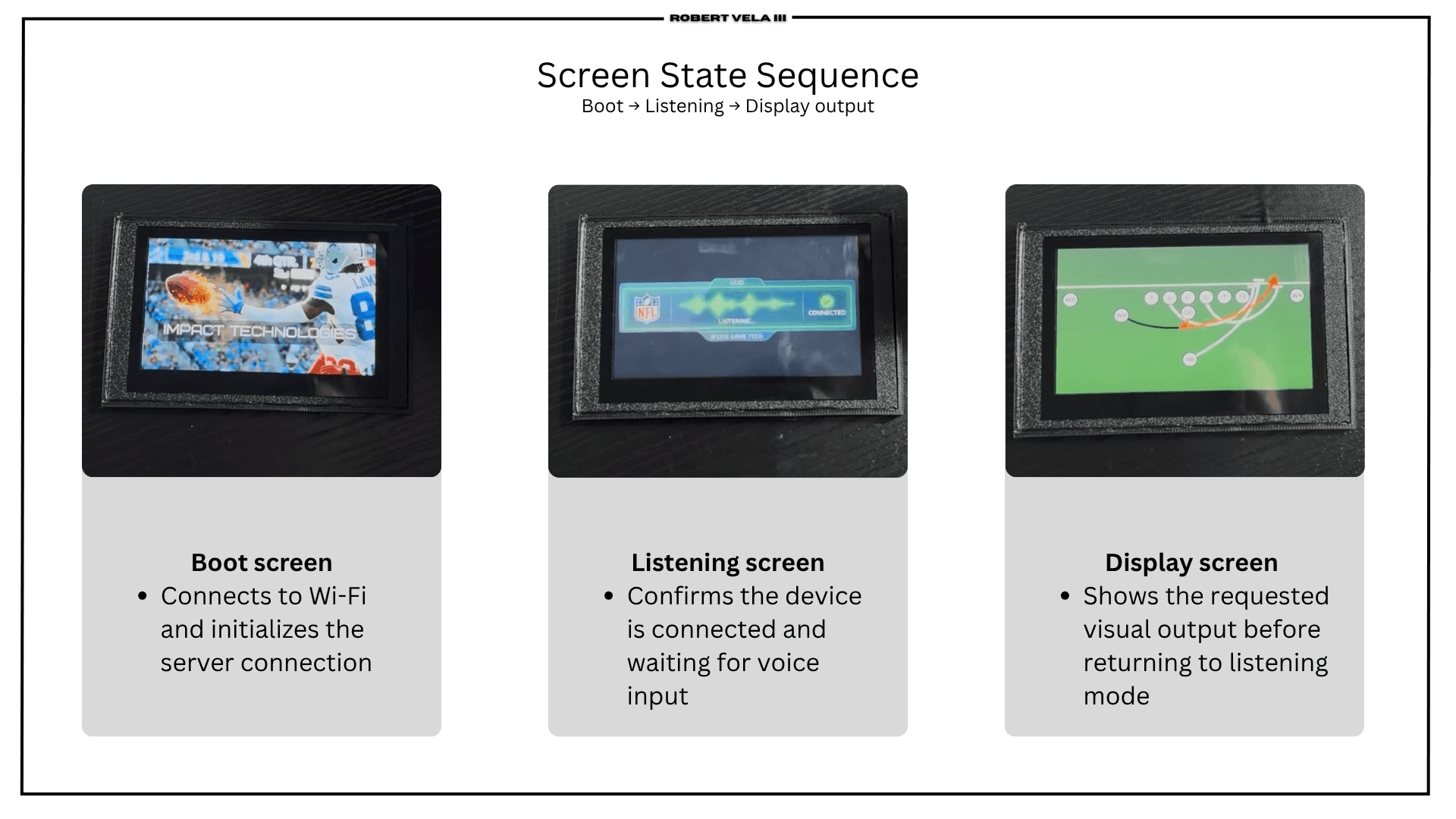
The display node implements a deterministic three-state machine — initialization, standby-listening, and tactical-output — each mapped to a discrete Binary RGB565 asset. State transitions are driven by HTTP response payload classification; framebuffer writes are followed by an immediate LVGL flush cycle to minimize perceived output latency. End-to-end propagation from acoustic event to raster output is approximately 2–3 seconds under local-network conditions.
System Specifications
Display Substrate
VIEWE UEDX80480043E-WB-A — 4.3″ IPS RGB, 800×480 px
Display MCU
ESP32-S3-N16R8 · 16 MB NOR Flash · 8 MB Octal SPI PSRAM
ASR Input Node
Seeed Studio XIAO ESP32-S3 · Integrated MEMS microphone · 2.4 GHz 802.11n
Acoustic Model
OpenAI Whisper tiny.en · Served via Python Flask (local inference)
Power Topology
3.7 V LiPo 2500 mAh · Parallel Y-harness · D3 cathode-injection bypass
Active System Draw
≈ 380 mA (dual-MCU aggregate load)
Estimated Runtime
≈ 6.5 h (C-rate: 0.152 C continuous)
Interrogation Cadence
HTTP GET /status at 500 ms fixed interval
End-to-End Latency
≈ 2–3 s (acoustic capture → framebuffer write)
Image Encoding
Binary RGB565, 800×480 px — 768 KB per frame
GUI Framework
LVGL v8.4 · 800 KB PSRAM framebuffer · lv_refr_now() flush
Transport Protocol
HTTP/1.1 multipart/form-data (upload) · plain-text GET (poll)
Next Iteration
Sensorless Actuation, Kinematic Context,
and Field-Domain Workflow Extension
The discrete push-to-transmit switch constitutes the final dexterity-dependent interaction in the input pipeline. Version 2 replaces it with surface EMG myoelectric classification, achieving fully hands-free command initiation and extending the system's applicability to high-motor-demand operational contexts.
EMG / Myoelectric Actuation
Volitional muscle contraction replaces the discrete PTT switch, eliminating all manual dexterity requirements from the input pipeline.
IMU-Based Kinematic Context
Six-degree-of-freedom inertial measurement enables orientation-dependent display-state arbitration.
GNSS Location Awareness
GPS-assisted geospatial context for position-relative tactical schema selection and field-domain disambiguation.
Anthropometric Soft-Goods Integration
Purpose-engineered compression substrate and enclosure topology for ergonomic wearability under field-operational constraints.
Structured Workflow Protocols
Domain-agnostic command taxonomy supporting training, emergency-response, and high-cognitive-load communication environments.